
The 15th India-Vietnam Defence Dialogue signalled a move from routine talks to deeper cooperation, with new deals on submarine rescue and defence industry to support stability in the Indo-Pacific, notes Dr Rajaram Panda.

As Japan beefs up its defences against China, both New Delhi and Tokyo seem to have decided to re-energise their relationship to ensure a strategic balance in Asia. It is a clear signal that they may be ready to work together in containing if not confronting China, says Nitin Gokhale.
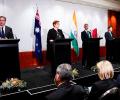
The foreign ministers of the Quad grouping of India, the US, Australia and Japan on Friday held extensive talks in Melbourne amid escalating tension between Russia and NATO countries over Ukraine, the Afghan crisis and increasing concerns over China's "coercion" in the Indo-Pacific region.

The top diplomats of Quad nations on Friday denounced as "inadmissible" any use or threat of use of nuclear weapons in the Ukraine war and strongly opposed any "unilateral actions" that seek to change the status quo in the South and East China Seas, a region that has witnessed increasing Chinese military offensive.
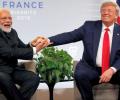
'The US President is joining the Prime Minister in addressing a huge Indian diaspora event in Houston and they will also meet on the margins of the UNGA in New York'

'This is the first time the US has formally recognised the threat India faces from terrorist organisations based in Pakistan.'

Having invested close to $15 billion in Indonesia, Indian firms have lined up further $15-16 billion investments.

Swaraj said there is scope to do a lot more and this would be an important element of their deliberations.

It seems China is ready to cooperate with India in the central Asian region through the SCO framework, the reasons for which are manifold, says Sana Hashmi.

Recognising the threat posed by outfits like the Al Qaeda, Lashkar-e-Tayiba and the Dawood Ibrahim network, India and the United States have agreed to deepen cooperation in fighting terrorism and asked Pakistan to bring to justice the 2008 Mumbai attack perpetrators.

India's doctrinal policy shift in combating terror by carrying out the Balakot air strikes inside Pakistan, appointment of a Chief of Defence Staff and hastening work on military modernisation marked a new beginning in 2019 in dealing with complex security challenges.

Prime Minister Modi told President Xi that he has made efforts to improve ties with Islamabad but these efforts have been "derailed".

"We have many relationships...they have a history. We will do what is in our national interest and part of that strategic partnership is the ability of each country to comprehend and appreciate the national interest of the other," Jaishankar said.

This is the joint statement issued by the ministry of external affairs on the visit of US President Barack Obama to India.

'It is in the interest of both sides that the visit of the US President is seen as being successful. Both sides have invested considerable political capital in it. This rapid exchange of visits and the decisions taken have to be justified, beyond the symbolism, which is no doubt important in itself. This opportunity to impart a fresh momentum to ties should not be missed,' says former foreign secretary Kanwal Sibal.

'We use the word "historic" perhaps too much, but the prime minister's visit certainly was historic in so many ways.'

'... For the India-US relationship to continue its positive trajectory, it will require India to adapt to a different approach.' Nisha Desai Biswal -- who as the Obama administration's point person for South Asia was in the inner circle of all the Obama-Modi Summits -- tells Rediff.com's Monali Sarkar why she is hopeful that India and the US are on an irreversible forward course.

'Whether it's investments in Kashmir, building naval facilities, or selling top-of-the-range military equipment, Pakistan could well benefit more under Xi's watch.' 'Do Chinese concerns about the 'Islamisation' of Pakistan give it pause about how quickly to move forward with security and economic projects? At the moment the indication is quite the opposite: China is doubling down on its support to Pakistan, partly because of its fears about where the country is headed.'
